Budapest to Vienna by Train: Time, Tickets & Stations
A direct train is the practical default between the two capitals. The important decisions are your Budapest station, fare conditions and whether to add a seat reservation.
Direct Railjet, Railjet Xpress and EuroCity trains connect Budapest with Vienna throughout the day. A typical Budapest-Keleti to Wien Hauptbahnhof journey takes about 2h50. MÁV currently advertises limited second-class fares from €13. Check the live train because schedules, inventory and engineering work vary by date.
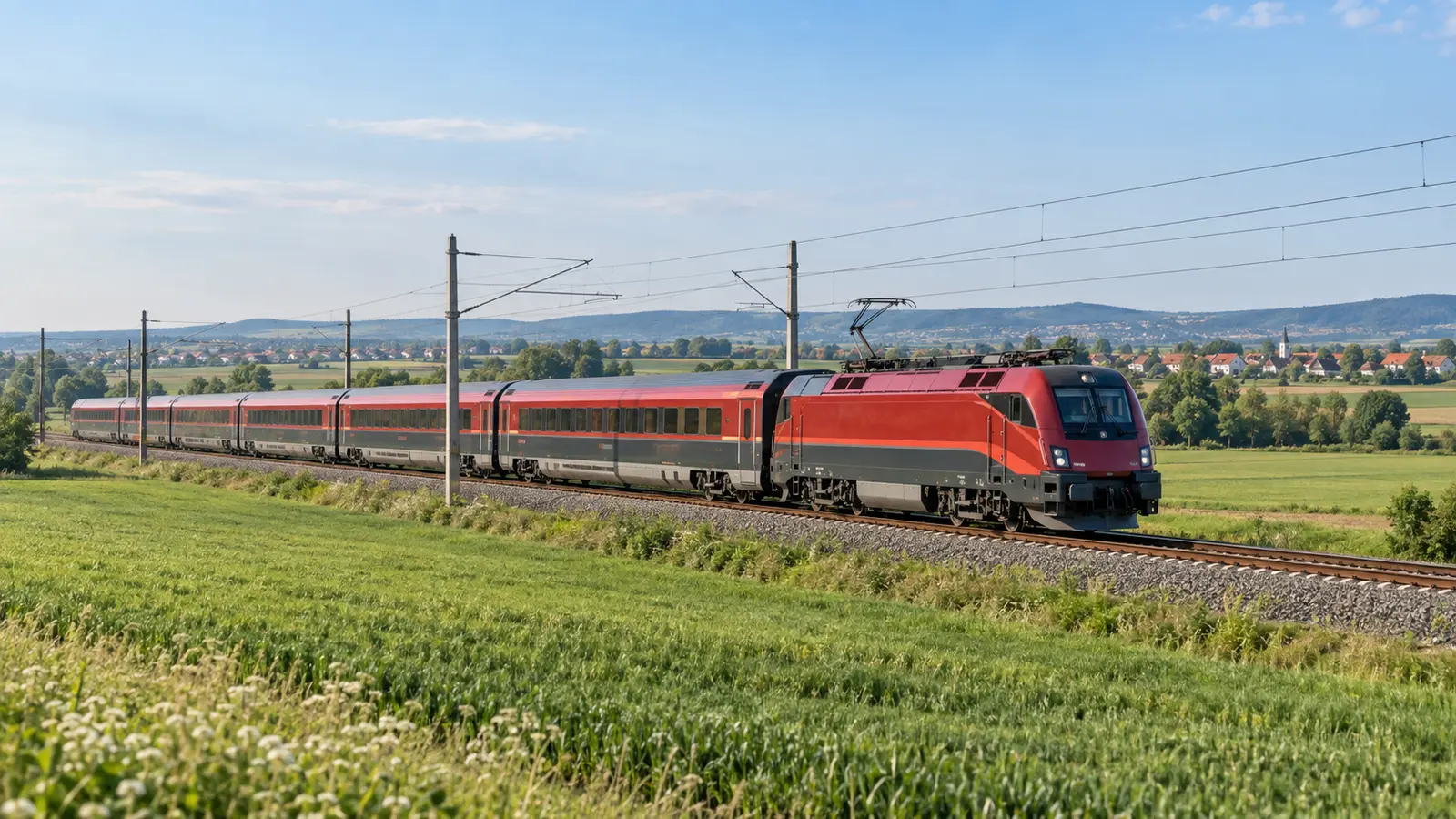
Budapest to Vienna train: essential facts
| Typical direct time | About 2h50 |
|---|---|
| Frequency | Hourly from early morning to evening |
| Main departure | Budapest-Keleti |
| Useful alternative stop | Budapest-Kelenföld |
| Arrival station | Wien Hauptbahnhof |
| Direct train types | Railjet, Railjet Xpress and EuroCity |
| Advertised starting fare | From €13, limited START Europa inventory |
| Seat reservation | Normally optional on Railjet; useful on busy dates |
Frequency, onboard features and the €13 starting fare were checked on MÁV’s official Austria page. The journey-time example comes from MÁV’s current Budapest–Vienna timetable, valid through October 14, 2026. Always use the live planner for your date.
How long is the train from Budapest to Vienna?
A typical direct Railjet or Railjet Xpress takes about 2 hours 50 minutes from Budapest-Keleti to Wien Hauptbahnhof. For example, the current route timetable shows regular departures at 07:30 and 08:30 arriving at 10:20 and 11:20.
That is a planning figure, not a guarantee for every train. EuroCity departures and temporary timetables may differ. MÁV explicitly warns that its international PDF shows major stops and can change during engineering work or operational disruption. Search the exact date again shortly before travel.
For the full hotel-to-hotel calculation, add the trip to your Budapest station and the onward journey from Wien Hbf. The direct train remains competitive because both stations connect easily with urban transport and there is no airport-style check-in.
Is there a direct Budapest to Vienna train?
Yes. MÁV describes an hourly service from early morning to evening in both directions. The current timetable includes Railjet, Railjet Xpress and EuroCity services, so the label may differ even when the itinerary is direct.
Choose by departure time, total fare and ticket conditions rather than by train name alone. Most of the international trains on this corridor offer a dining car, an accessible travel option and bicycle carriage, but equipment can vary. If a bicycle space or accessibility service is essential, confirm it for the specific departure before paying.
Which Budapest and Vienna stations should you use?
Budapest-Keleti
Budapest-Keleti is the clearest default for a first trip. It is the origin shown for many direct services and has metro and local transport connections. Arrive 20–30 minutes early if you do not know the station, then check the train number and platform on the departure board.
Budapest-Kelenföld
The same international train usually calls at Budapest-Kelenföld after leaving Keleti. Kelenföld can save time if you are staying in Buda or arriving on Metro line M4. Do not board there by assumption: select Kelenföld in your search and confirm that it appears on the ticket.
Wien Hauptbahnhof
Wien Hauptbahnhof—shown as Wien Hbf—is Vienna’s main long-distance station. It is not Wien Mitte or Westbahnhof. Use the exact station name when planning your hotel transfer, especially if a map app suggests a closer but different Vienna station.
How much are Budapest to Vienna train tickets?
MÁV currently advertises second-class START Europa tickets from €13 from Budapest to Vienna. That is limited advance inventory, not a fixed route price. The ticket is tied to the selected train and is non-refundable. MÁV also lists more flexible START Europa Plus fares from €41, subject to their own conditions.
Compare the exact same departure on the official MÁV ticket site and ÖBB ticket shop. A small price difference matters less than the currency, refund terms, included reservation and support channel attached to the booking.
- Search the actual travel date. Entry fares can disappear as the cheaper allocation sells.
- Use the exact stations. Start with Budapest-Keleti and Wien Hbf, then compare Kelenföld if useful.
- Open the conditions. Check whether the fare is restricted to one train and whether it can be refunded.
- Compare the final total. Include any separate seat reservation before choosing the seller.
- Save the ticket offline. Keep the PDF or app ticket available without mobile data.
It is an advertised minimum for limited inventory. Budget using the live price for your date, especially for Fridays, Sundays, holidays and short-notice travel.
Do you need a seat reservation?
A seat reservation is normally an add-on rather than a requirement on daytime Railjet services. ÖBB lets you select a reservation during or after the ticket purchase. The reservation applies only to the named train, date, route and class.
Reserve when traveling on Friday or Sunday, during holidays, with a group or when sitting together matters. ÖBB notes that the claim to the seat expires if it is not occupied within 15 minutes after departure from the station named on the reservation.
Reservation rules checked on ÖBB’s official seat-reservation page.
Luggage, food and bicycles
There is no airline-style baggage check-in. You carry and store your own luggage, so use a case you can lift into the train and manage through the station. Keep valuables and travel documents with you rather than in a distant luggage rack.
MÁV says most trains on the Austria route have a dining car and can carry bicycles. A bicycle place should be checked and booked in advance where required; do not rely on turning up with a full-size bike. For a practical packing limit, see our European train luggage guide.
Passport and border checks
Hungary and Austria are both in the Schengen area, so there is no routine airline-style border process when the train crosses the frontier. Police checks and temporary internal border controls can still occur.
Carry a valid passport or national identity document. Non-EU travelers should also carry any visa or residence document required for their nationality and status. The European Union’s official travel guidance explains that internal checks are normally absent but authorities can perform police checks.
Can you use Eurail or Interrail?
An eligible Eurail or Interrail pass can be useful on this international daytime corridor, but confirm the exact train in the pass planner and check whether the selected operator asks for a reservation. Compare the value of one pass travel day plus any reservation with a normal advance ticket.
The broader calculation belongs in our Eurail Pass value guide. Keeping pass strategy on its dedicated page avoids confusing a simple Budapest–Vienna ticket decision with a multi-country pass comparison.
Is Budapest to Vienna a realistic day trip?
It is technically possible, but a return journey uses roughly 5 hours 40 minutes before station access. A day trip works best with an early direct train, a late return and one focused plan in Vienna. For most travelers, at least one night produces a calmer trip and better value from the travel time.
If Vienna is part of a longer Central European journey, continue with the separate Vienna to Prague train guide, Vienna to Salzburg guide or the one-hour Vienna to Bratislava train guide. Each page owns one route so the station, fare and timing advice stays clear.
Building a Munich, Vienna, Budapest and Prague itinerary? Start with the separate Munich to Vienna train guide and Prague to Budapest train guide, then arrange the order and overnight stops in our Europe Route Planner before buying restricted tickets.
Frequently asked questions
How long is the train from Budapest to Vienna?
A typical direct Railjet or Railjet Xpress takes about 2 hours 50 minutes from Budapest-Keleti to Wien Hauptbahnhof. Exact times vary by departure and during engineering work, so check the dated timetable before travel.
Is there a direct train from Budapest to Vienna?
Yes. Direct Railjet, Railjet Xpress and EuroCity services run on the route. MÁV currently describes an hourly service from early morning until evening in both directions.
Which stations does the Budapest to Vienna train use?
The simplest search is Budapest-Keleti to Wien Hauptbahnhof. Direct trains also call at Budapest-Kelenföld, which can be more convenient for some travelers. Confirm the station printed on your ticket.
How much is the train from Budapest to Vienna?
MÁV currently advertises limited START Europa tickets from €13 in second class. These low fares are train-specific and non-refundable, and the available price for your date may be higher.
Do I need a seat reservation from Budapest to Vienna?
A separate seat reservation is not normally compulsory on daytime Railjet services, but it is sensible for Friday and Sunday travel, holidays and other busy dates. Check the conditions attached to your exact train and ticket.
Do I need a passport from Budapest to Vienna by train?
There is no routine airline-style border process because Hungary and Austria are in the Schengen area, but temporary checks are possible. Carry a valid passport or identity document and any visa or residence document required for your status.
The practical verdict
Choose a direct train from Budapest-Keleti—or Kelenföld when it is genuinely more convenient—to Wien Hbf. Plan on about 2h50, compare MÁV and ÖBB for the same departure, read the low-fare restrictions and reserve a seat for a busy date.
Vienna to Prague by train
Compare direct Railjet and RegioJet times, stations, tickets and reservation choices.
Read the Vienna–Prague guide →Information checked September 16, 2026. Timetables, fares, train equipment, ticket conditions and border controls can change. Verify the exact departure and rules with MÁV or ÖBB before travel.