What Size Luggage for a 2-Week Europe Train Trip?
The best bag is not the biggest one an operator allows. It is the biggest one you can lift onto a rack, carry upstairs and move through a busy station without help.
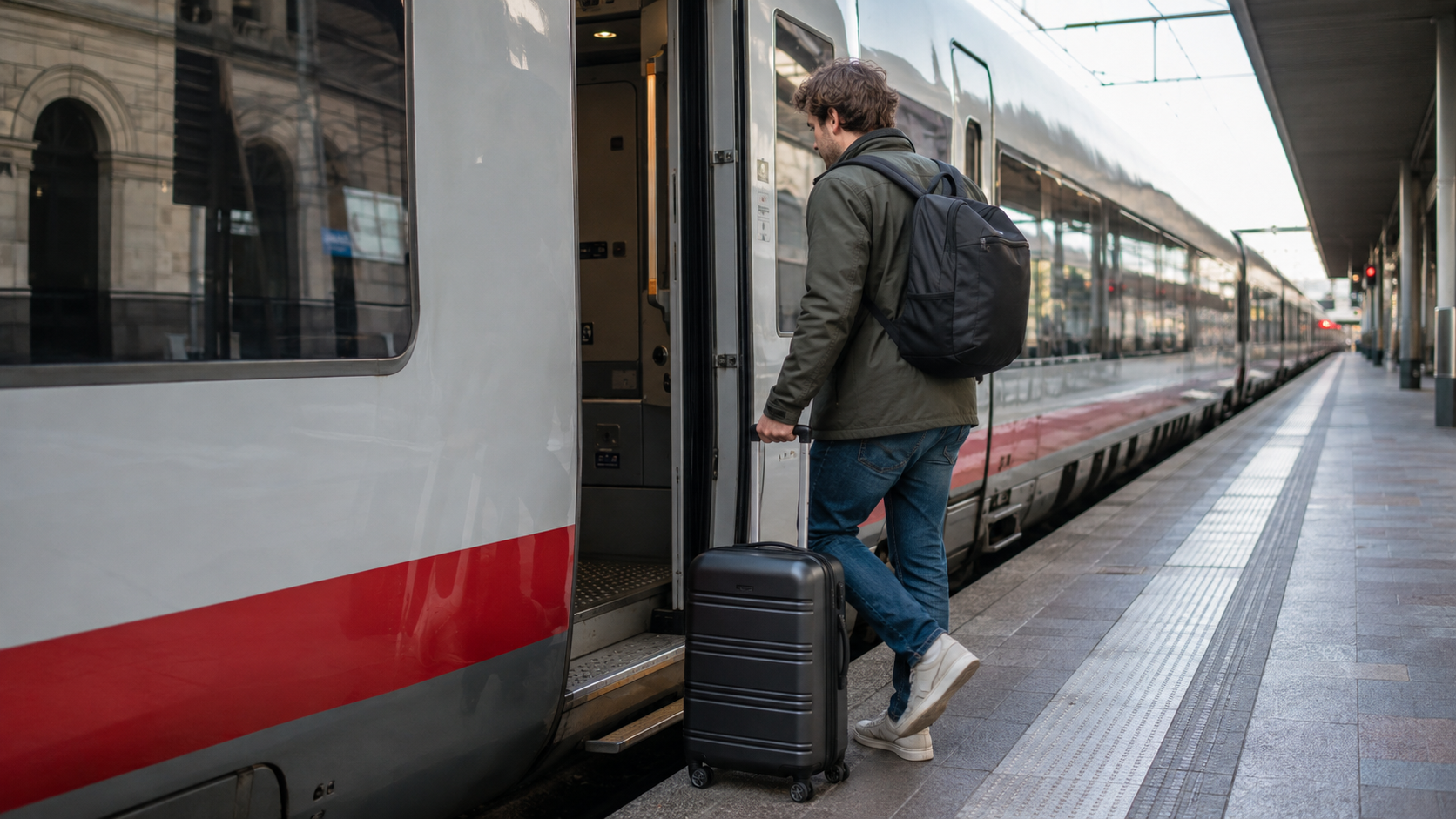
For most two-week Europe train trips, choose a 60–65 cm medium suitcase with roughly 55–70 liters of capacity, plus a 15–25 liter daypack. Pack about seven days of clothes and do laundry once. Try to keep the main bag below 15–18 kg even when the operator allows more.
The best luggage size by travel style
| Trip style | Recommended main bag | Capacity | Best for |
|---|---|---|---|
| Fast-moving | 45–55 cm carry-on | 35–45 L | Frequent transfers, stairs and budget trains |
| Balanced two-week trip | 60–65 cm medium suitcase | 55–70 L | Most summer and shoulder-season itineraries |
| Slow or winter trip | 68–72 cm large suitcase | 70–90 L | Few hotel changes, bulky layers and taxi transfers |
A 60–65 cm case is large enough for a second pair of shoes and a light jacket, yet short enough to turn in narrow aisles. A 70–80 cm case may be allowed but quickly becomes awkward on stairs, cobbles and crowded platforms.
Use the lift test before you leave
Pack the suitcase completely, then perform these four movements at home. If one feels unsafe, remove weight or choose a smaller bag.
- Lift the bag from floor to waist height without dragging it.
- Carry it up and down one full flight of stairs.
- Turn it through a narrow doorway without hitting the frame.
- Lift and store it in about 15 seconds while wearing your daypack.
European rail luggage is usually self-service. A generous allowance does not mean there will be a porter, an elevator or an empty floor-level rack when you board.
Where luggage goes on European trains
- Overhead shelves: best for backpacks, carry-ons and light medium cases.
- End-of-car racks: designed for medium and large suitcases, but fill first on popular routes.
- Luggage towers: vertical shelves inside some modern high-speed coaches.
- Between seat backs: a useful hidden space on trains with seats facing opposite directions.
- Under the seat: keep your daypack, documents, electronics and medicine close to you.
Board as soon as your train is announced, label the main bag and keep valuables in the smaller bag. Never leave luggage in a doorway, aisle or wheelchair space.
European train luggage rules compared
There is no single luggage allowance for every European train. The operator, route and ticket product determine the rule.
| Operator | Published allowance | Useful size rule |
|---|---|---|
| Eurostar Standard | 2 large bags + 1 hand item; no weight limit | Up to 85 cm on London routes; other routes may use 75 cm |
| SNCF TGV INOUI | 2 suitcases + 1 small item, or 1 suitcase + 1 special item + 1 small item | Suitcase 90 × 70 × 50 cm; small item 40 × 30 × 15 cm |
| Renfe | Up to 3 pieces, 25 kg and 290 cm combined | Largest piece up to 85 × 55 × 35 cm |
| Renfe Avlo basic fare | 1 hand item + 1 cabin bag included | 36 × 27 × 25 cm and 55 × 35 × 25 cm |
| Trenitalia | Luggage travels free in designated spaces | It must not obstruct passengers, staff, doors or aisles |
Rules checked on the official Eurostar luggage page, SNCF luggage guide, Renfe luggage policy, Avlo help page and Trenitalia FAQ. Check your exact train before travel.
Why 24 inches is the sweet spot
A case sold as 24 inches usually sits in the 60–65 cm medium category, although wheel and handle measurements vary by brand. It gives noticeably more space than an airline carry-on without becoming a full-size case.
Do not shop by the marketing label alone. Check the external height including wheels, the empty weight and the usable liters. A light 62 cm case is generally more practical than a reinforced 70 cm case that already weighs 5 kg empty.
A realistic two-week packing list
Pack for one week, not fourteen separate outfits. Schedule laundry around day six or seven.
| Category | Suggested amount |
|---|---|
| Tops | 5–7, including layers |
| Bottoms | 3–4 versatile pairs |
| Underwear and socks | 7–8 sets |
| Shoes | 1 worn pair + 1 packed pair |
| Outerwear | 1 weather-appropriate jacket |
| Toiletries | Travel sizes; restock locally |
| Laundry | Small detergent sheets or local laundrette budget |
Use two or three packing cubes rather than compressing everything into a dense block. A case that closes only when expanded will be harder to lift and leaves no room for food, a wet jacket or a small purchase.
Backpack, two wheels or four wheels?
| Bag type | Main advantage | Main drawback |
|---|---|---|
| Travel backpack | Hands free on stairs and uneven streets | Heavy on long station walks; less organized |
| Two-wheel suitcase | Larger wheels cope better with cobbles and gaps | Must be pulled and occupies more space behind you |
| Four-wheel spinner | Easy to move beside you on smooth station floors | Small wheels struggle on cobbles and can roll on trains |
For a typical city-to-city trip, either a light medium spinner or a sturdy two-wheel case works. Choose a backpack only if you can carry the packed weight comfortably for at least 15 minutes.
Adjust for winter, summer and mobility
- Summer: a 45–55 cm carry-on may be enough if accommodation has laundry.
- Winter: wear the bulkiest coat and boots in transit; use compression only for soft layers.
- Many transfers: stay at 60–65 cm or smaller, even for winter.
- Limited mobility: reduce bag weight, prefer direct trains and reserve assistance with each operator in advance.
- Family travel: one manageable bag per capable traveler is usually easier than one enormous shared case.
Six mistakes that make train luggage harder
- Using the operator’s maximum allowance as a packing target.
- Bringing fourteen full outfits instead of planning one laundry stop.
- Packing three or four pairs of shoes.
- Keeping passports, medicine and chargers in the main suitcase.
- Buying a case without checking its empty weight and external dimensions.
- Assuming every station has working lifts and every train has floor-level racks.
Frequently asked questions
What size luggage is best for a two-week Europe train trip?
A 60–65 cm medium suitcase of about 55–70 liters plus a 15–25 liter daypack is the best balance for most travelers. Keep the packed case below 15–18 kg if possible.
Is a 24-inch suitcase enough for two weeks in Europe?
Yes. It is normally a medium case and works well if you pack seven days of clothes, repeat outfits and do laundry once.
Can I bring a large suitcase on European trains?
Often yes, but allowances vary and storage can fill. Bring it only if you can lift it and keep it clear of aisles and doors.
Is there a luggage weight limit?
Not a universal one. Eurostar has no weight limit but requires self-carry, while Renfe publishes a 25 kg combined limit on many services. Check the exact operator and fare.
Where do suitcases go?
Small bags go overhead or under the seat. Medium and large cases normally use end-of-car racks, luggage towers or the spaces between back-to-back seats.
Is a backpack or suitcase better?
A backpack wins on stairs and cobbles; a suitcase wins on smooth station floors and in hotels. The best choice is the one you can lift safely when fully packed.
The practical verdict
For two weeks by train, start with a medium 60–65 cm suitcase, cap the packed weight at what you can lift comfortably and add one small daypack for valuables. Pack seven days of clothing and wash once. A larger case adds capacity, but it also turns every staircase, tight connection and full luggage rack into a bigger problem.
Is the Swiss Travel Pass worth it?
Compare 2026 pass prices with regular tickets, Saver Day Passes and the Half Fare Card.
See the break-even examples →Luggage policies checked August 17, 2026. Operator limits, ticket inclusions and onboard storage can change. Verify the current rules for every train and fare before travel. Europe Rail Trip is independent and does not sell train tickets or luggage.