Munich to Prague by Train: Time, Tickets & Direct Trains
The direct train avoids a change and gives you a scenic cross-border ride through Regensburg, the Bavarian Forest and western Czechia—but current works make a final timetable check important.
A direct train normally runs every two hours from München Hbf to Praha hl.n.. The fastest scheduled journey takes about 5h33. The service is branded alex RE25 in Germany and Západní expres in Czech route information. Check traffic alerts because construction can replace the regular timetable.
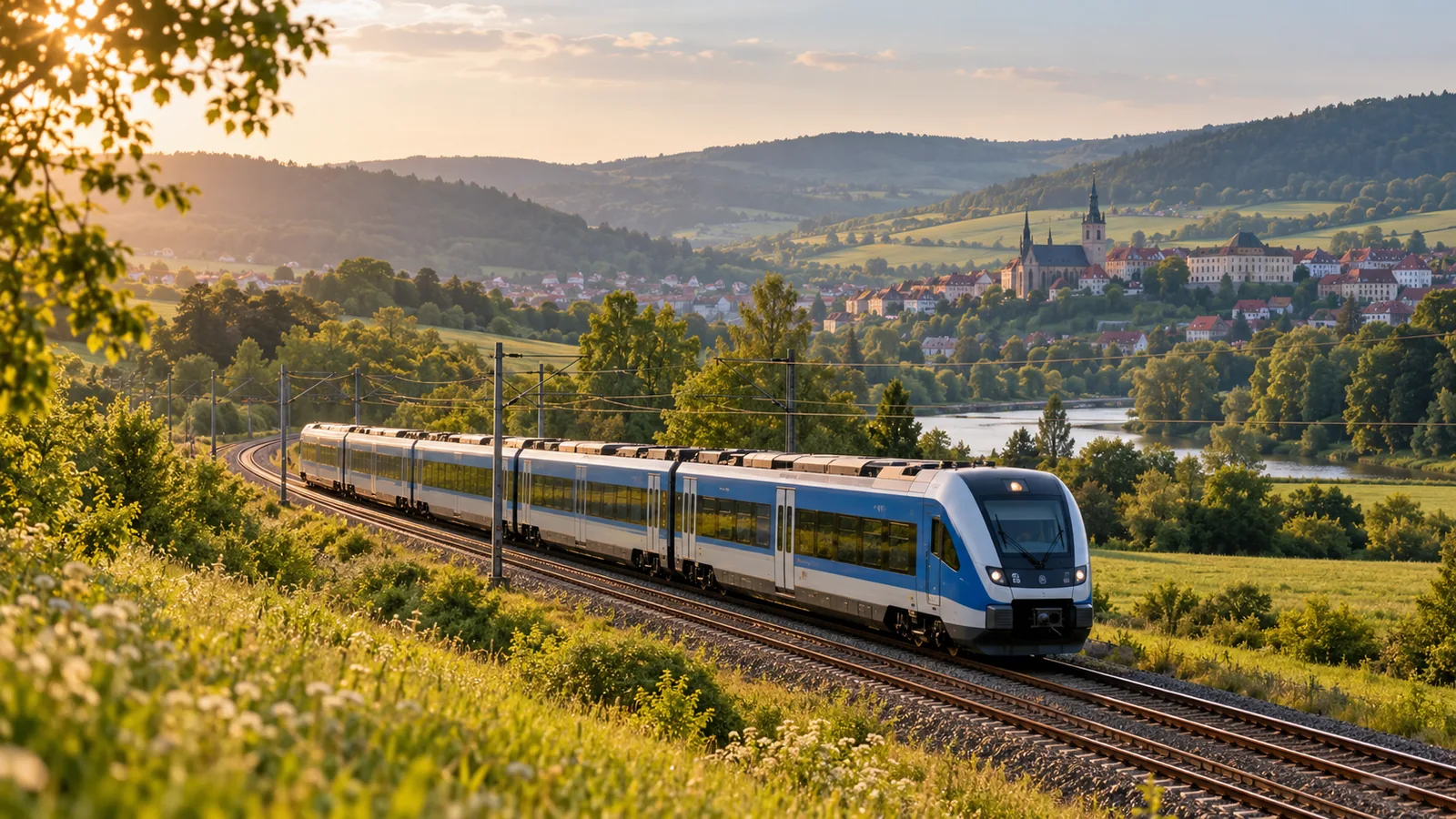
Munich to Prague by train at a glance
| Fastest direct time | About 5h33 |
|---|---|
| Typical frequency | Every 2 hours |
| Departure station | München Hbf |
| Arrival station | Praha hl.n. |
| German service number | RE25 |
| Czech route name | Západní expres |
| Advertised starting fare | From 368 CZK, limited inventory |
| Seat reservation | Usually optional; helpful when busy |
Journey time, frequency and the 368 CZK entry fare were checked on České dráhy’s official Prague–Munich route page. The operator lists RE25 between München Hbf and Praha hl.n. in its 2025/26 alex timetable.
Is there a direct train from Munich to Prague?
Yes. The direct service normally runs every two hours. In Germany it appears as alex RE25, while Czech sources use Západní expres for the Prague–Munich express corridor. The same physical journey can therefore carry different labels in different planners.
The train travels through Regensburg, Schwandorf, Furth im Wald, Domažlice and Plzeň. At the border and at operating handovers, staff or locomotives may change, but passengers stay with the direct train when the itinerary is running normally. Confirm that the search result shows zero changes rather than assuming every departure is through-running.
The official alex page states that its regular timetable is valid from December 14, 2025 until December 12, 2026. It also warns that the PDF excludes construction changes. Open the operator’s traffic reports as well as the dated journey planner before travel.
How long is the Munich to Prague train?
The fastest direct itinerary takes about 5 hours 33 minutes. Other departures can be slightly slower. This route is not a high-speed line: it uses a scenic regional and intercity corridor with several stops, single-track sections and operational handovers.
For a door-to-door comparison, add the trip to München Hbf and the transfer from Praha hl.n. The train still avoids airport transfers, early check-in and liquid restrictions. A midday arrival is possible with an early departure, while a later train can protect a final morning in Munich.
Do not plan a separate non-refundable train only minutes after arrival. When works or cross-border delays occur, recovery can take longer than on a dense domestic corridor. Use our connection checker if you must continue the same day.
Which stations does the route use?
München Hauptbahnhof
München Hauptbahnhof, shown as München Hbf, is Munich’s main station. It is connected to the U-Bahn, S-Bahn, trams and local buses. Construction around the station can alter walking routes, so arrive 25–30 minutes early if you have luggage or need to find a specific platform.
Praha hlavní nádraží
Praha hlavní nádraží, shown as Praha hl.n., is Prague Main Station. Metro line C stops beneath it, and Wenceslas Square is within walking distance. Use the station name from your ticket in directions instead of a generic “Prague station” search.
Important intermediate stops
Regensburg and Plzeň are the major intermediate cities. The route then crosses the Bavarian and Bohemian forest area through Furth im Wald and Domažlice. Stop patterns can vary, so check the selected train before using it for an intermediate journey.
How much are Munich to Prague train tickets?
České dráhy advertises limited fares from 368 CZK on the route in the Prague-to-Munich direction. Use that only as evidence that low advance inventory exists—not as a promise for a Munich departure. Your live price depends on the date, direction, seller, flexibility and remaining allocation.
Compare the same train through the ČD connection search and Deutsche Bahn journey planner. Make sure both results cover the entire cross-border trip rather than only the German or Czech section.
- Enter the city-centre stations. Search München Hbf to Praha hl.n.
- Choose a direct result. Confirm that the planner shows zero changes.
- Compare identical departures. Match the time and service number before comparing price.
- Read the restrictions. The cheapest ticket may be tied to one train and have limited refunds.
- Check the reservation. See whether a seat is included, optional or unavailable for part of the journey.
- Save the itinerary and ticket. Keep both available offline.
A separate German and Czech ticket can look cheaper, but passenger-rights protection across the split may differ. Prefer one through ticket unless you understand the connection and refund consequences.
Do you need a seat reservation?
A seat reservation is normally optional on the direct train. It can still be valuable in summer, on Friday or Sunday, during Oktoberfest, around Christmas markets and for a group. ČD specifically recommends adding a reservation on long-distance international trains.
The through service crosses operators and national systems, so reservation displays may not be identical in every shop. If a seat map is unavailable, you may receive an assigned seat automatically or need to purchase the reservation separately. Check the final basket rather than assuming that “ticket” includes a seat.
Eligible Eurail and Interrail passes cover the participating railway services, but passholders still need to add the journey correctly and follow reservation guidance. The official Eurail Czechia guide is a starting point; our Eurail value guide helps compare a travel day with an advance ticket.
What is the journey like?
The first part crosses Bavaria toward Regensburg and Schwandorf. The line then enters a greener, more rural landscape near the border before continuing through Domažlice and Plzeň to Prague. It is a pleasant daytime ride rather than a dramatic panoramic railway.
ČD lists air-conditioned first- and second-class coaches, Wi-Fi, power sockets and a trolley minibar on Západní expres services. Treat these as planned features, not a guarantee for every coach on every day. Bring water and enough food for a journey longer than five hours.
Mobile coverage and Wi-Fi can weaken in rural and forested sections. Download tickets, entertainment and offline maps before departure. If you plan to work, assume that connectivity will be intermittent rather than continuous.
Luggage, bicycles and accessibility
There is no airline-style luggage check-in. You lift and store your own bags above the seat, beneath it or in a rack. A medium case that you can carry up steps is more practical than the largest airline suitcase; see our European train luggage guide.
ČD says bicycle spaces require a reservation on this service. Do not arrive with a full-size bicycle without checking capacity for the exact departure. Folding bikes may follow different rules when packed as luggage.
Accessible toilets and wheelchair spaces are listed among planned facilities, but assistance arrangements differ by operator and station. Contact the seller or operating railway in advance when a lift, wheelchair space or boarding assistance is essential.
Passport and border checks
Germany and Czechia are in the Schengen area, so there is no routine airport-style border process on the train. Police checks and temporary internal controls are still possible. Carry a valid passport or national identity document plus any visa or residence document required for your status.
The European Union’s official travel page explains the general document rules. A digital photo of a passport is not a substitute for the original document when authorities require it.
Direct train or connection via Nuremberg?
The direct RE25 is normally the simplest choice because it removes transfer risk. Journey planners sometimes offer a faster-looking itinerary via Nuremberg with a bus or multiple trains. Compare the total time, number of changes, ticket protection and luggage handling before choosing it.
A connection may be useful when direct trains are disrupted or sold at an unattractive fare. Build a real buffer, especially when separate tickets are involved. The direct route’s slower speed is balanced by staying on one train for most or all of the journey.
If Munich is one stop in a longer Central European trip, continue with our Munich to Salzburg guide, Munich to Vienna guide, Vienna to Prague guide and Prague to Budapest guide before fixing the order.
How to build the route into an itinerary
Allow at least two full days in each city. A practical sequence is Munich → Prague → Vienna → Budapest, but the best order depends on flights and hotel prices. Use the Europe Route Planner to compare travel days before buying restricted tickets.
For travelers coming from northern Germany, the Berlin to Prague train is faster than detouring through Munich. Choose the gateway that fits the rest of your trip, not simply the route with the cheapest headline fare.
Avoid booking a timed attraction immediately after arrival. Keep the first evening flexible so that ordinary rail disruption does not turn into a chain of missed reservations.
Frequently asked questions
How long is the train from Munich to Prague?
The fastest direct journeys take about 5 hours 33 minutes. Exact times vary by departure and during construction work, so check the live timetable for your date.
Is there a direct train from Munich to Prague?
Yes. The direct service is shown as RE25 in Germany and Západní expres or an express train in Czech information. It normally runs every two hours between München Hbf and Praha hl.n.
How much is the train from Munich to Prague?
České dráhy currently advertises limited fares from 368 CZK in the Prague-to-Munich direction. Live prices depend on the date, seller, fare conditions and remaining inventory, so compare the same train on ČD and Deutsche Bahn.
Do I need a seat reservation from Munich to Prague?
A reservation is normally optional, but it is useful on weekends, holidays and summer travel. Availability and coach layouts can differ across the German and Czech parts of the route.
Which stations does the direct Munich to Prague train use?
Use München Hauptbahnhof and Praha hlavní nádraží. The direct route travels through Regensburg, Schwandorf, Furth im Wald and Plzeň; confirm the exact stop pattern for the selected train.
Can Eurail or Interrail be used from Munich to Prague?
Eligible global passes cover the participating operators, but you should still add the train to your pass and check reservation advice. Compare one pass day with a normal advance ticket before deciding.
The practical verdict
Choose the direct RE25/Západní expres for the easiest Munich to Prague trip. Plan on about 5h33, compare one through ticket on ČD and DB, reserve a seat when demand is high and check alex traffic reports close to departure. The route is slower than a high-speed railway but wins on simplicity and city-centre access.
Prague to Budapest by train
Compare direct daytime trains, the sleeper, stations, fares and seat reservations.
Read the Prague–Budapest guide →Information checked October 11, 2026. Timetables, fares, works, train formations, ticket conditions and border controls can change. Verify the exact departure with alex, Deutsche Bahn or České dráhy before purchase.