Brussels to Frankfurt by Train: Time, Tickets & Direct ICE
A direct ICE links Brussels-Midi with Frankfurt’s main station in under three hours. Here is how to choose the right station, fare and reservation without overcomplicating the trip.
The direct Brussels to Frankfurt train takes about 2 hours 52 minutes. ICE services run from Brussels-Midi/Zuid to Frankfurt(Main) Hbf, with up to eight departures a day in Deutsche Bahn’s advertised timetable. Limited fares start from €37.99 in second class.
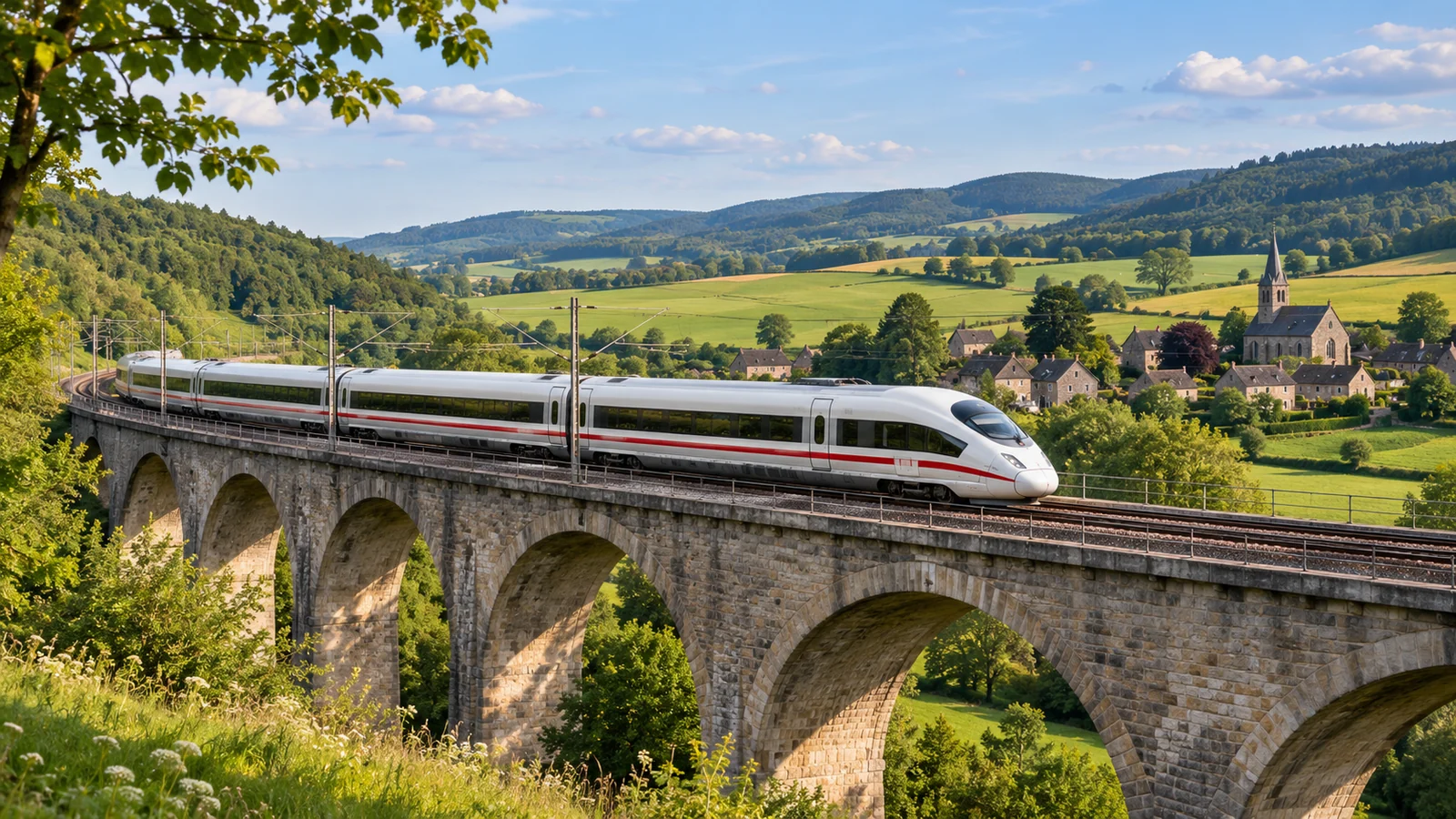
Brussels to Frankfurt by train at a glance
| Fastest direct journey | About 2h52 |
|---|---|
| Departure | Brussels-Midi / Brussel-Zuid |
| Arrival | Frankfurt(Main) Hbf |
| Direct operator | Deutsche Bahn ICE |
| Advertised frequency | Up to 8 direct trains daily |
| Reservation | Normally optional; recommended when busy |
| Advertised entry fare | From €37.99 second class |
How long is Brussels to Frankfurt by train?
Deutsche Bahn advertises the fastest direct ICE at about 2 hours 52 minutes, so the route is comfortably under three hours. Individual departures may be a few minutes longer depending on the stop pattern. The usual route serves Liège and Aachen before continuing through Cologne toward Frankfurt.
The train is competitive with flying because Brussels-Midi and Frankfurt Hbf are central and there is no airport transfer or baggage collection. Compare the full trip from hotel to hotel. For most city-centre journeys, rail is both simpler and more useful.
Journey time and frequency checked on Deutsche Bahn’s official Brussels connection page and European business-travel guide.
Is there a direct Brussels to Frankfurt ICE?
Yes. Up to eight direct ICE trains a day are advertised between Brussels and Frankfurt. Select a journey with zero changes and stay in the same train. The direct option avoids a platform change in Cologne, which is particularly useful with bags, children or a short onward plan in Frankfurt.
SNCB International describes the ICE link between Belgium and Germany with multiple daily departures. Frequency can change during engineering work, so the live planner remains authoritative for the date you actually travel.
The Belgian operator’s overview is available on the official SNCB international-travel page.
Which Brussels station should you use?
Book Brussels-Midi, called Brussel-Zuid in Dutch. These are two names for the same station. It is south of the historic centre and connected by frequent local trains, metro, trams and buses. Do not accidentally start a search at Brussels-Central: a planner may add a short domestic train to Midi, making a direct international trip look like it requires a change.
If arriving from London, Eurostar uses Brussels-Midi too, but international tickets do not automatically protect every self-made onward connection. Follow the guidance in our London to Brussels guide and leave a real buffer.
Arriving at Frankfurt(Main) Hbf
Frankfurt Hauptbahnhof is the city’s main central station. Booking systems use Frankfurt(Main) Hbf to distinguish it from Frankfurt an der Oder. Trams outside the station and the underground S-Bahn and U-Bahn connect with the Old Town, museums, fairgrounds and airport.
The station is large, but the main concourse is straightforward. If continuing on a separate ticket, allow time to walk from the international ICE platform and check the new departure board.
Current facilities and station notices are listed on Deutsche Bahn’s official Frankfurt(Main) Hbf page.
How much are Brussels to Frankfurt tickets?
Deutsche Bahn advertises limited second-class fares from €37.99 and first-class fares from €56.99. Those are entry prices, not a fixed tariff. The cheapest allocations can disappear on Friday afternoons, Sundays, holidays and trade-fair dates.
Search early, then compare nearby trains. A slightly later direct ICE can cost less than a connection. Always inspect the cancellation and train-binding conditions before payment, especially when the lowest price looks unusually good.
Which DB fare should you choose?
| Fare | Best for | Main trade-off |
|---|---|---|
| Super Sparpreis Europa | Lowest advance price | Train-specific and usually no voluntary refund |
| Sparpreis Europa | Value with limited cancellation | Train-specific; fee and conditions apply |
| Flexpreis Europa | Plans that may change | Higher price |
First class brings more space and can include a reservation depending on the fare and booking channel. Compare the total, not only the class label. Second class is perfectly adequate for a journey under three hours.
Do you need a seat reservation?
Outside a specifically announced compulsory period, an ICE seat reservation is normally optional. Your ticket lets you travel, but it does not always guarantee a particular seat. Reserving is sensible for busy services, groups and anyone who wants to work or sit together.
Look for the reservation option during checkout. If no seats are shown, the train may still be bookable, but you risk standing for part of the journey. Deutsche Bahn explains that reservations can also be purchased separately for long-distance trains.
Reservation options checked on Deutsche Bahn’s official long-distance seat-reservation page.
When should you book?
Book when the timetable opens and your date is firm. Dynamic advance fares usually rise as the cheaper inventory sells, rather than dropping predictably at the last minute. Business peaks and major Frankfurt events can affect both price and occupancy.
If continuing beyond Frankfurt, search the complete route. A through-ticket can make disruption easier to manage. For a separate onward ticket, use our connection checker and choose a buffer that reflects the size of Frankfurt Hbf.
How early should you arrive at Brussels-Midi?
Arrive about 20–30 minutes before the ICE departure. There is no airline check-in and no sealed terminal for a Brussels–Frankfurt train. Use the main board, confirm the train number and walk to the platform. Be ready before boarding closes.
Allow more time if arriving by metro, collecting a ticket or unfamiliar with Midi. The station signs use both French and Dutch, so Brussels-Midi and Brussel-Zuid mean the same place.
Passport and checks entering Germany
Belgium and Germany are in the Schengen area, but passengers should carry the passport or national identity document valid for their journey. Deutsche Bahn states that checks can take place on international ICE trains entering Germany, often onboard while the train continues moving.
Keep identification accessible. A check does not require the airport-style process used on London trains, but it can occupy a few minutes and is another reason not to build an extremely tight separate connection.
Current information is published on Deutsche Bahn’s official border-controls page.
Luggage, bikes and onboard comfort
There is no airline-style baggage check. You carry bags onto the ICE and store them in overhead racks, under the seat or in floor-level luggage areas. Deutsche Bahn asks passengers to bring only luggage they can handle themselves and to keep aisles and doors clear.
ICE trains usually provide power sockets, Wi-Fi, toilets and onboard food service, though equipment can change. Bikes require more planning because international high-speed capacity is limited; verify the exact train before buying.
General handling rules are on Deutsche Bahn’s official luggage page. Our European luggage guide covers practical suitcase sizes.
What if the direct train is sold out?
Compare earlier and later direct trains first. A common alternative changes at Cologne, where frequent German ICE services continue to Frankfurt. Book the whole itinerary in one transaction and allow a useful transfer rather than chasing the shortest theoretical connection.
Our Brussels to Cologne guide explains the first leg. If your itinerary starts in France, compare the direct Paris to Frankfurt train instead of forcing a Brussels connection.
Is Frankfurt a sensible day trip?
A day trip is feasible because the direct journey is under three hours. An early train and evening return can leave time for the Römerberg, riverfront and one museum. However, a disruption could shorten the visit, and six hours of return rail travel still makes it a long day.
An overnight stay is more comfortable and opens onward routes. For a Low Countries itinerary, compare Amsterdam to Frankfurt and Amsterdam to Brussels.
Frequently asked questions
How long is Brussels to Frankfurt by train?
The fastest direct ICE takes about 2 hours 52 minutes.
Is the train direct?
Yes. Up to eight daily ICE services are advertised from Brussels-Midi/Zuid to Frankfurt(Main) Hbf.
How much does it cost?
Limited second-class fares start from €37.99 and first class from €56.99, subject to availability.
Is a seat reservation compulsory?
Normally not outside an announced compulsory period, but reserving is wise on busy international trains.
Is Brussels-Midi the same as Brussels-Zuid?
Yes. Midi is the French name and Zuid the Dutch name for the same station.
Do I need identification?
Carry the passport or national identity document accepted for your journey because checks can occur.
The practical verdict
Choose the direct ICE from Brussels-Midi/Zuid to Frankfurt(Main) Hbf, reserve a seat when the train is likely to be busy and compare fare flexibility before paying. At about 2h52, this is an easy city-centre rail trip.
Browse the Germany train travel hub, or continue through the Rhine corridor with Amsterdam to Cologne.
Amsterdam to Frankfurt by train
Compare the direct ICE, €38 entry fare, reservations and stations.
Read the Amsterdam–Frankfurt guide →Information checked November 9, 2026. Operators can change timetables, fares, border checks and ticket conditions. Verify the live journey before purchase.