Paris to Frankfurt by Train: Time, Tickets & Direct Trains
Direct ICE and TGV trains connect central Paris with central Frankfurt in under four hours. This guide explains the right stations, fare types, compulsory reservation and border practicalities.
The fastest current Paris to Frankfurt train takes about 3 hours 53 minutes direct. Book from Paris Gare de l’Est to Frankfurt(Main) Hbf. Deutsche Bahn advertises limited France fares from €46.99; the reservation is compulsory and included.
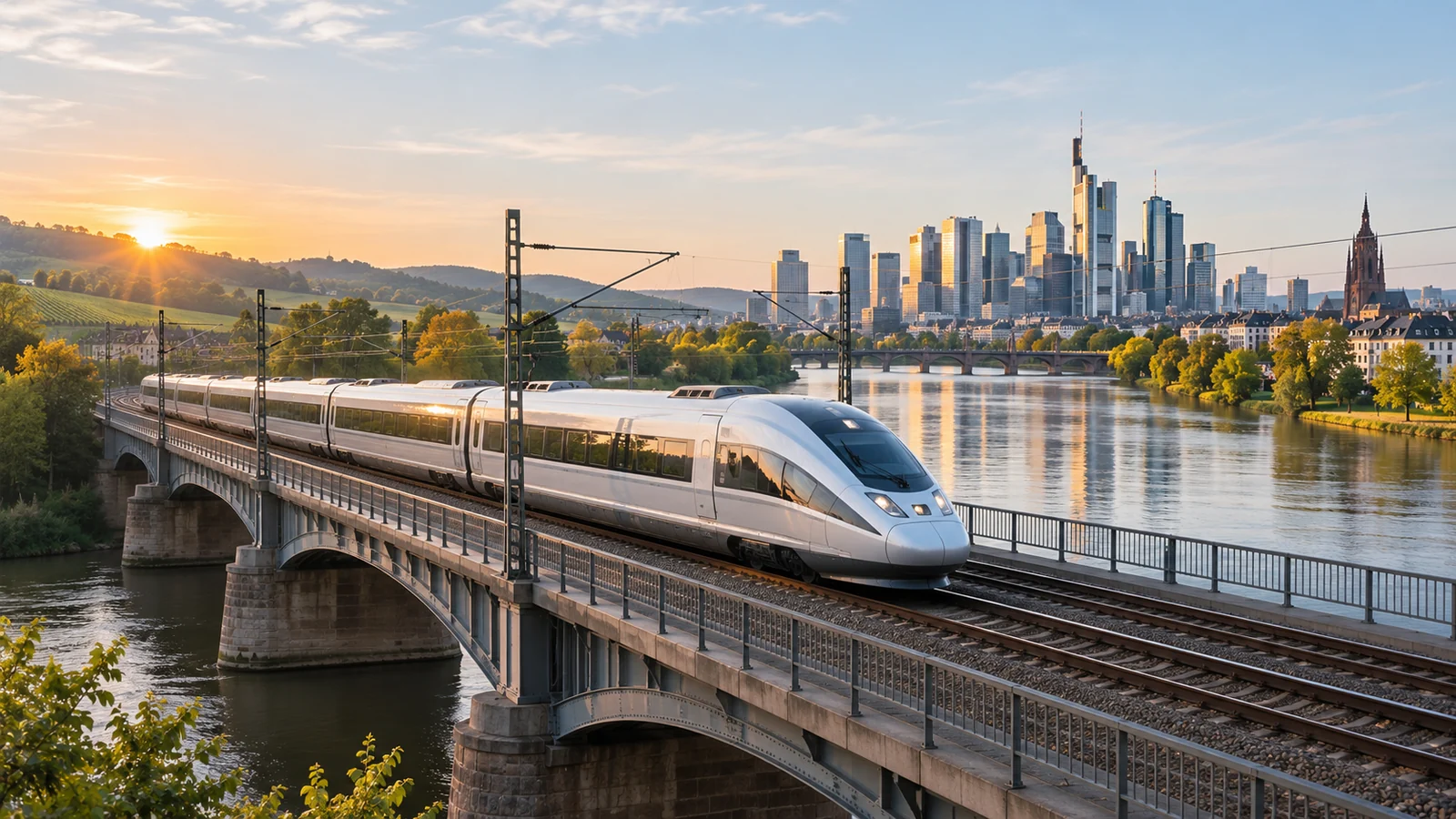
Paris to Frankfurt by train at a glance
| Fastest current direct journey | About 3h53 |
|---|---|
| Departure | Paris Gare de l’Est |
| Arrival | Frankfurt(Main) Hbf |
| Direct trains | ICE or TGV INOUI under DB-SNCF cooperation |
| Changes | None on a direct service |
| Seat reservation | Compulsory and included |
| Advertised entry fare | From €46.99; limited availability |
How long is the Paris to Frankfurt train?
Current SNCF journey searches show the fastest direct trip at roughly 3 hours 53 minutes, with an average near 4 hours 11 minutes on the date checked. Deutsche Bahn also describes the international high-speed link as taking around 3 hours 40 minutes in favorable timetables. Treat the live result for your day as the deciding figure: stopping patterns, engineering work and seasonal schedules can add time.
The rail comparison is especially strong because both stations are central. You avoid the transfers to Charles de Gaulle or Frankfurt Airport, airline check-in and baggage collection. For many city-centre journeys, a four-hour train is simpler than a shorter flight.
Times and current availability checked on the official SNCF Connect Paris–Frankfurt route page and Deutsche Bahn’s Paris connection guide.
Is there a direct Paris to Frankfurt train?
Yes. Select a journey marked direct and stay on the same train from Paris Gare de l’Est to Frankfurt(Main) Hbf. Services are jointly offered by Deutsche Bahn and SNCF, using either an ICE or TGV INOUI. The train type changes the interior more than the journey: both use the same high-speed international corridor.
Some search results include a change in Mannheim, Karlsruhe or Saarbrücken. Those can be useful when the direct train is expensive or sold out, but they add platform risk. A direct departure is normally worth a modest premium, particularly with luggage or children.
Which stations should you choose?
Paris Gare de l’Est
Book Gare de l’Est, not Gare du Nord. The terminals are only a short walk apart, but they have separate concourses and departure boards. Gare de l’Est is served by Métro lines 4, 5 and 7. If you arrive on Eurostar at Gare du Nord, follow our Gare du Nord–Gare de l’Est walking guide and allow extra time rather than treating them as one station.
Frankfurt(Main) Hbf
Frankfurt Hauptbahnhof is the central station. The booking name often appears as Frankfurt(Main) Hbf; “Main” distinguishes Frankfurt am Main from Frankfurt an der Oder. Trams, U-Bahn and S-Bahn connect the station with the Old Town, museums, trade fair and airport.
Facilities, accessibility and current station notices are listed on Deutsche Bahn’s official Frankfurt(Main) Hbf station page.
How much are Paris to Frankfurt tickets?
Deutsche Bahn advertises long-distance France fares from €46.99, while SNCF searches can show entry prices around €49. These are limited advance fares, not a fixed price. Popular morning, Friday and Sunday trains usually climb first. Search early and compare departures across the same day.
DB’s lowest Super Sparpreis Europa fare is tied to the booked long-distance train and usually has the strictest conditions. Sparpreis Europa can offer limited cancellation for a fee, while Flexpreis Europa costs more in exchange for flexibility. SNCF may present different labels, so rely on the rules shown beside the actual fare rather than the color or name alone.
Entry fare checked on Deutsche Bahn’s official France saver-fare page.
When should you book?
Book once the timetable opens and your date is firm, especially for school holidays, trade fairs and weekends. The route uses dynamic pricing: waiting does not create a guaranteed last-minute bargain. If your plans may change, compare the flexible fare now instead of assuming you can cheaply alter a restrictive ticket later.
Check the train number, date, station and passenger names before payment. When continuing beyond Frankfurt, book the complete itinerary together where possible. One through-ticket provides clearer assistance if the international train arrives late.
Is a seat reservation required?
Yes. Deutsche Bahn confirms that reservations are compulsory on ICE and TGV services to and from Paris. The reservation is included when you buy the international ticket, so you do not need to add another seat. Sit in the coach and seat printed on the booking.
This differs from most domestic German ICE journeys, where a seat reservation is normally optional. If you change to a different train, verify that the replacement ticket includes a valid reservation for that service.
The rule is confirmed in Deutsche Bahn’s official compulsory-reservation FAQ.
ICE or TGV: which is better?
Choose the departure time and fare conditions before the train brand. Both ICE and TGV offer reserved seating, power and onboard catering, although equipment can change. First class provides more space, but it is not necessary for a journey under four hours.
A direct standard-class train at a useful time is usually better value than a premium cabin with an awkward schedule. If working en route, compare the specific seat map and remember that Wi-Fi quality can vary across borders.
How early should you arrive at Gare de l’Est?
Aim to be inside the station 20–30 minutes before departure. There is no London-style Eurostar terminal and no airline check-in, but you need time to read the departure board, find the platform and walk to the correct coach. Doors can close shortly before departure.
Allow longer if transferring across Paris, traveling with large bags or unfamiliar with the station. Keep the ticket and identification accessible. Platform numbers may appear only after the train is prepared.
Passport and border checks
France and Germany are in the Schengen area, but travelers must still carry the passport or national identity document valid for their nationality and journey. Deutsche Bahn warns that checks can occur on international ICE and TGV trains entering Germany, often while the train is moving.
A check is not the same as an airport immigration terminal. Remain in your seat, follow staff instructions and keep documents close. Requirements vary by nationality, so confirm entry rules separately when needed.
Current onboard checks are explained on Deutsche Bahn’s official border-controls page.
Luggage rules on the direct train
You carry and store your own luggage. For the DB-SNCF cooperation, SNCF states a maximum size of 130 × 90 cm per item. The practical limit is what you can lift onto the train and place safely in the racks without blocking doors or aisles.
A medium suitcase plus a day bag is easier than the theoretical maximum. Label luggage and keep passports, phones and valuables with you. Read our European train luggage guide and rail-trip packing list before choosing a bag.
Cooperation-train dimensions checked on SNCF Connect’s official luggage information page.
What happens if the direct train is sold out?
First compare earlier and later direct departures. If none works, search one change via Mannheim, Karlsruhe or Saarbrücken and prefer a through-ticket with a sensible buffer. Avoid assembling two unrelated tickets around a short transfer simply to save a small amount.
Another useful route is Paris to Cologne followed by a German ICE to Frankfurt. It is slower than the direct train, but our Paris–Cologne guide explains that first leg. Use the connection checker to judge whether a transfer is comfortable.
Can Frankfurt be a day trip from Paris?
It is technically possible with early and late direct trains, but nearly eight hours of return rail travel makes it a demanding day. An overnight stay leaves time for the Römerberg, Main riverfront, museums and Sachsenhausen without watching the clock.
Frankfurt also works as a hub. Continue to Cologne, Berlin, Munich or the Rhine Valley. Compare the alternative Brussels to Frankfurt ICE and Amsterdam to Frankfurt ICE if building a multi-city trip.
Frequently asked questions
How long is Paris to Frankfurt by train?
The fastest current direct trip is about 3 hours 53 minutes. Individual trains can be closer to four hours.
Is there a direct train?
Yes. Direct ICE and TGV trains run from Paris Gare de l’Est to Frankfurt(Main) Hbf.
How much does it cost?
Limited advance fares are advertised from €46.99, with current searches sometimes showing seats near €49.
Do I need a seat reservation?
Yes. It is compulsory on the direct Paris–Germany ICE and TGV and included with the ticket.
Which Paris station should I use?
Use Paris Gare de l’Est. Do not go to Gare du Nord, although it is nearby.
Do I need identification?
Carry the passport or national identity document accepted for your journey because checks can occur.
The practical verdict
Book a direct departure from Gare de l’Est to Frankfurt(Main) Hbf, compare the actual flexibility rules and arrive 20–30 minutes early. With a reserved seat and a city-centre journey under four hours, rail is the natural option.
Explore more German routes in our Germany train travel guide, or compare Paris alternatives with Paris to Zurich and Paris to Milan.
Brussels to Frankfurt by train
Compare the direct ICE, current entry fares, stations and reservations.
Read the Brussels–Frankfurt guide →Information checked November 9, 2026. Operators can change timetables, fares, border checks and ticket conditions. Verify the live journey before purchase.