Is the Bernina Express Worth It? Cost vs Regional Trains
The famous red train and ordinary regional services share the same Alpine railway. The real decision is whether a reserved panorama seat and simpler journey justify the extra cost.
The Bernina Express is worth it for a first-time traveler who values a reserved seat, large panorama windows and one easy sightseeing experience. It is not necessary for the scenery: regional trains use the same railway and offer more flexibility. In 2026, St. Moritz–Tirano costs CHF 65 in second class without a pass, including the compulsory reservation.
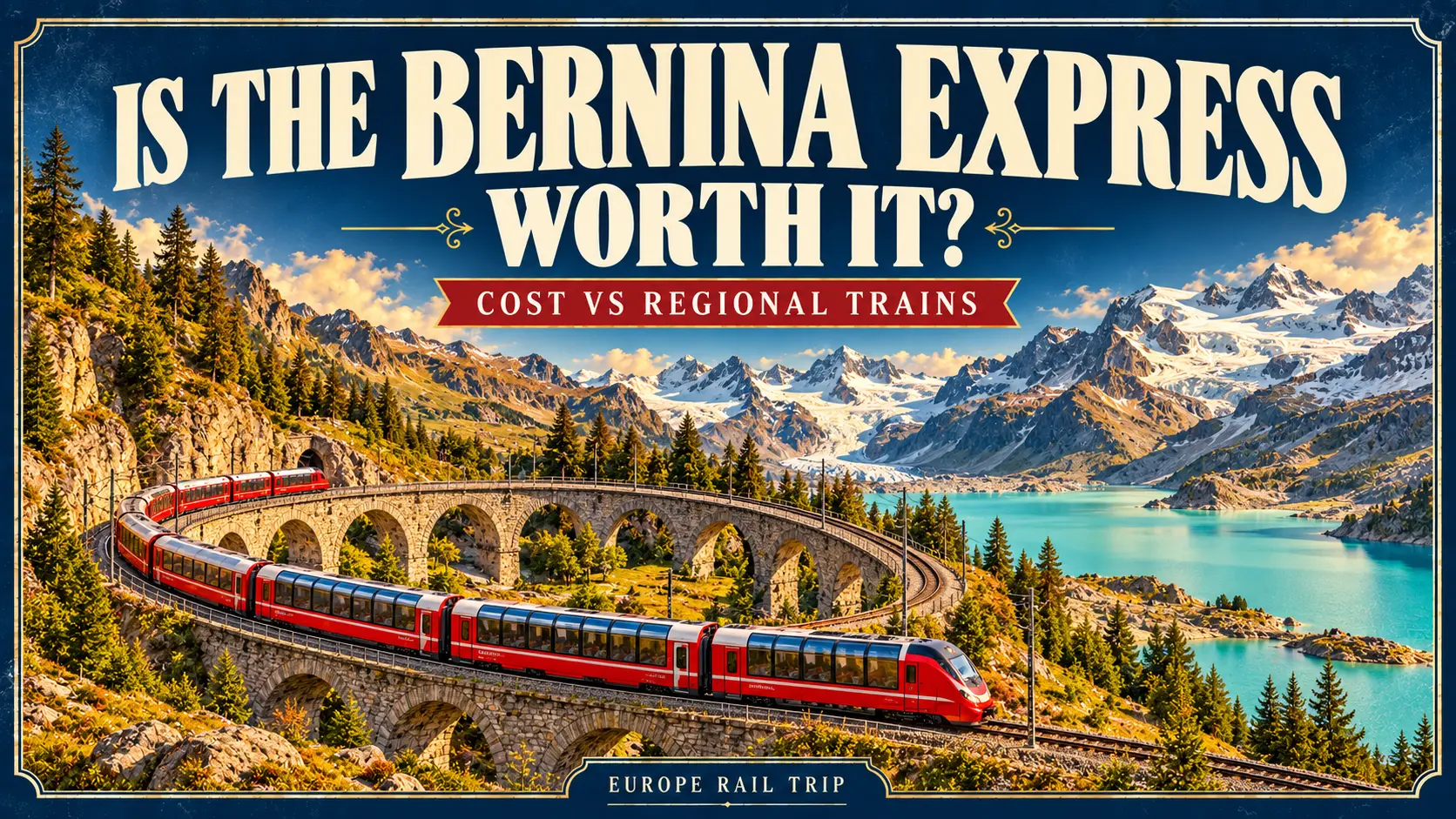
Is the Bernina Express worth it at 2026 prices?
For most first-time visitors, yes—especially on the shorter St. Moritz–Tirano journey. The official 2026 fare is CHF 33 in second class, and the compulsory short-route seat reservation is CHF 32. That creates a total of CHF 65 without a pass. First class costs CHF 57 plus the same reservation, or CHF 89.
The longer Chur–Tirano journey costs CHF 66 in second class. Its reservation is CHF 40 in low season and CHF 44 from May 2 to October 25, 2026, so the total is CHF 106–110. The longer route includes the Albula section and Landwasser Viaduct before joining the Bernina Line, which explains why some travelers prefer it despite the extra time.
| 2026 journey | 2nd-class ticket | Reservation | Total |
|---|---|---|---|
| St. Moritz–Tirano | CHF 33 | CHF 32 | CHF 65 |
| St. Moritz–Tirano, 1st class | CHF 57 | CHF 32 | CHF 89 |
| Chur–Tirano, low season | CHF 66 | CHF 40 | CHF 106 |
| Chur–Tirano, main season | CHF 66 | CHF 44 | CHF 110 |
| Eligible pass holder | Covered when valid | CHF 32–44 | Reservation only |
Ticket prices, seasonal reservation supplements and pass acceptance checked in Rhaetian Railway’s official 2026 sales manual. Prices remain subject to change.
What does the Bernina Express premium buy?
The extra payment buys certainty and presentation. The panorama car has large windows, an assigned seat and onboard information about the route. You board once, keep the same place and watch the landscape change from Alpine lakes and glaciers to the warmer Valtellina valley in Italy.
From Chur, the train crosses 196 bridges and passes through 55 tunnels. The route includes the Landwasser Viaduct, the UNESCO-listed Albula and Bernina railway, Lago Bianco, Alp Grüm and the circular Brusio Viaduct. The St. Moritz–Tirano section takes about 2 hours 15 minutes; Chur–Tirano takes about four hours.
However, the supplement does not buy a different railway, guaranteed weather or a guaranteed quiet carriage. The panoramic glass can create reflections for photography. Storage is also limited, so a large suitcase makes the day less comfortable.
Route highlights, current timetable, duration and luggage guidance checked on the official Rhaetian Railway Bernina Express page.
Bernina Express vs regional trains
Regional Rhaetian Railway trains travel on the same Bernina Line. They do not use the branded panorama cars and may require a change, but the mountains, viaducts, glaciers and lakes do not disappear. This makes the ordinary train the strongest alternative for a budget traveler.
| Decision | Bernina Express | Regional trains |
|---|---|---|
| Scenery | Same railway corridor | Same railway corridor |
| Seat | Compulsory assigned reservation | Usually unreserved; optional reservation on selected trains |
| Windows | Large fixed panorama glass | Ordinary windows; some are easier for photos |
| Changes | Direct on the selected service | May require a change |
| Stops | Fixed train and itinerary | Easy to pause at Alp Grüm or Poschiavo |
| Extra cost | CHF 32–44 compulsory reservation | No panorama supplement; CHF 5 optional seat reservation where offered |
| Best for | Simple premium experience | Value, flexibility and photography |
RhB states clearly that the regular trains are not part of the Bernina Express, do not have panorama cars and do not include the extra onboard services. On selected regional trains, a seat reservation costs CHF 5 per person. That is a much smaller commitment than the branded train’s compulsory surcharge.
Regional-train reservation and service differences checked on RhB’s official Bernina Line reservation page and its current explainer on Bernina Express versus regional trains.
Who should book the panorama train?
| Traveler | Verdict | Reason |
|---|---|---|
| First visit to the Bernina route | Worth it | Simple, memorable and easy to understand |
| Swiss Travel Pass holder | Often worth it | Only the reservation may remain to pay |
| Budget traveler | Choose regional | Same line without the panorama supplement |
| Photographer | Choose regional | More stops and less reflective windows |
| Traveler with large luggage | Consider regional | Panorama-car storage is limited |
| Family wanting guaranteed seats | Worth considering | Assigned seats reduce uncertainty |
| Flexible bad-weather plan | Choose regional | No expensive fixed panorama reservation |
The simplest test is whether you value the train itself as an attraction. If the answer is yes, the CHF 32 St. Moritz–Tirano reservation is reasonable. If your only goal is to see the landscape or move between Switzerland and Italy, a regional itinerary offers stronger value.
Which route section gives the best value?
St. Moritz to Tirano is the best-value first trip. It includes the Bernina Pass, Ospizio Bernina, Lago Bianco, Alp Grüm, Val Poschiavo and the Brusio spiral before reaching Italy. The route is short enough to enjoy without giving up a full day, and the 2026 second-class total is CHF 65.
Chur to Tirano is better when the Albula railway and Landwasser Viaduct matter. The journey includes more variety but requires roughly four hours on the train and a higher seasonal reservation. It makes the most sense when Chur is already part of the itinerary.
Do not pay for Chur–Tirano only to backtrack to St. Moritz the same day. Build the direction around hotel stays. Our 7-day Switzerland train itinerary helps place the journey, while our Switzerland–Italy route guide explains when Tirano is a useful international gateway.
Is first class worth it?
First class is a comfort upgrade, not a scenery upgrade. Both classes use panorama cars and travel over the same line. The reservation surcharge is identical, but the St. Moritz–Tirano transport fare rises from CHF 33 to CHF 57.
Pay for first class if extra space and a quieter layout improve a two- to four-hour journey. Stay in second class if value matters more. The CHF 24 difference on the short route can buy lunch in Tirano or contribute to another Swiss train day.
A first-class ticket does not create better views through cloud or snow. Choose the class for space and comfort, then check the forecast separately.
Passes, reservations and booking
The Swiss Travel Pass is accepted as the transport ticket on the Bernina Express, but the compulsory reservation remains payable. Eurail and Interrail travelers should confirm current coverage for the exact section and class. A pass does not create a seat until the Bernina reservation is booked.
Reserve early for peak summer, weekends and a fixed itinerary. The 2026 main season runs from May 2 through October 25 for the long-route surcharge. If you are booking late, RhB currently promotes limited last-minute packages sold online within six days of departure, but they are not exchangeable or refundable and should not replace an advance plan.
- Choose St. Moritz–Tirano or Chur–Tirano before comparing prices.
- Confirm whether your pass covers the transport ticket.
- Book the compulsory seat for the exact Bernina Express train.
- Check border documents because Tirano is in Italy.
- Recheck engineering work and the live timetable before travel.
Booking conditions and the current short-notice offer checked on RhB’s official Bernina Express last-minute page. The page also lists the October 29–November 13, 2026 diversion for trains 951 and 952.
What is the best time of year?
Summer offers long daylight, green valleys and the widest choice of Bernina Express departures. Autumn adds color and thinner crowds. Winter can be spectacular because snow creates stronger contrast around the pass, but daylight is shorter and the service pattern changes.
Weather matters more than the month. A fixed panorama reservation is easier to justify when the forecast is stable. Regional trains remain the safer choice when you want to move the excursion by a day. RhB also operates open scenic carriages on selected summer dates, which can interest photographers but offer a very different experience from the enclosed panorama coach.
The 2026 open-carriage period was checked on RhB’s official open scenic carriages page.
Bernina Express or Glacier Express?
Choose Bernina for concentrated scenery and a shorter day. Choose Glacier Express for an eight-hour journey between Zermatt and St. Moritz with a more elaborate full-day onboard format. Bernina is easier to combine with northern Italy, while Glacier Express works as a cross-Switzerland transfer.
The Bernina value case is stronger for many travelers because the short route costs less and gives faster visual variety. For the complete comparison, use our Glacier Express value guide. To compare Bernina, Glacier, GoldenPass and Gotthard on one page, use our Swiss scenic trains guide.
Frequently asked questions
Is the Bernina Express worth it?
Yes for a first visit when you want a reserved panorama seat, a direct sightseeing experience and less planning. Regional trains use the same railway and are better value for travelers who prefer flexibility, stops and no compulsory panorama-train surcharge.
How much does the Bernina Express cost in 2026?
For St. Moritz to Tirano, the official 2026 second-class fare is CHF 33 plus a CHF 32 compulsory reservation, or CHF 65 total without a pass. Chur to Tirano is CHF 66 plus a CHF 40 low-season or CHF 44 main-season reservation.
Is the Bernina Express included in the Swiss Travel Pass?
The Swiss Travel Pass is accepted as the transport ticket, but every traveler still pays the compulsory Bernina Express seat reservation. Confirm that the pass is valid for the whole section you book.
Can I take a regional train on the same Bernina route?
Yes. Regular Rhaetian Railway trains run on the same Bernina Line between St. Moritz and Tirano. They do not have the panoramic-car service and may involve a change, but they show the same landscape.
Which is better, Bernina Express or regional train?
Choose Bernina Express for one reserved seat, large panorama windows and a simple branded experience. Choose regional trains for a more flexible schedule, optional stops, ordinary windows that can be better for photos and no mandatory Bernina Express surcharge.
Is first class worth it on the Bernina Express?
First class offers more space and a quieter layout, but the scenery and reservation surcharge are the same. Second class is the better value for most travelers because both classes use panorama cars on the same route.
The practical verdict
Is the Bernina Express worth it? Yes for a first journey, especially St. Moritz–Tirano in second class. The CHF 65 total buys an assigned panorama seat and a simple two-hour-fifteen-minute experience across one of Europe’s most dramatic railways.
Choose regional trains when flexibility, photography or cost matters more than presentation. You will still cross the same Bernina Pass and see the same lakes, glaciers and viaducts. The branded train improves the experience; it does not own the landscape.
Best scenic train rides in Switzerland
See how Bernina, Glacier, GoldenPass, Gotthard and Luzern–Interlaken differ.
Compare the scenic trains →Information checked September 30, 2026. Fares, reservation supplements, pass validity, timetables, seasonal service and engineering work can change. Verify the exact journey with Rhaetian Railway before purchase.