How Long Is Train From Paris to Milan? 2026 Guide
The direct daytime train crosses the Alps and removes the airport transfer at both ends. Here is the realistic journey time, current disruption warning and safest booking strategy.
How long is train from Paris to Milan? A direct high-speed train normally takes about 6 hours 30 minutes to 7 hours from Paris Gare de Lyon. Trenitalia schedules two daily Frecciarossa round trips and SNCF also sells direct TGV INOUI services. However, international trains are suspended through October 9, 2026 because of works, so search your exact date before relying on the normal timetable.
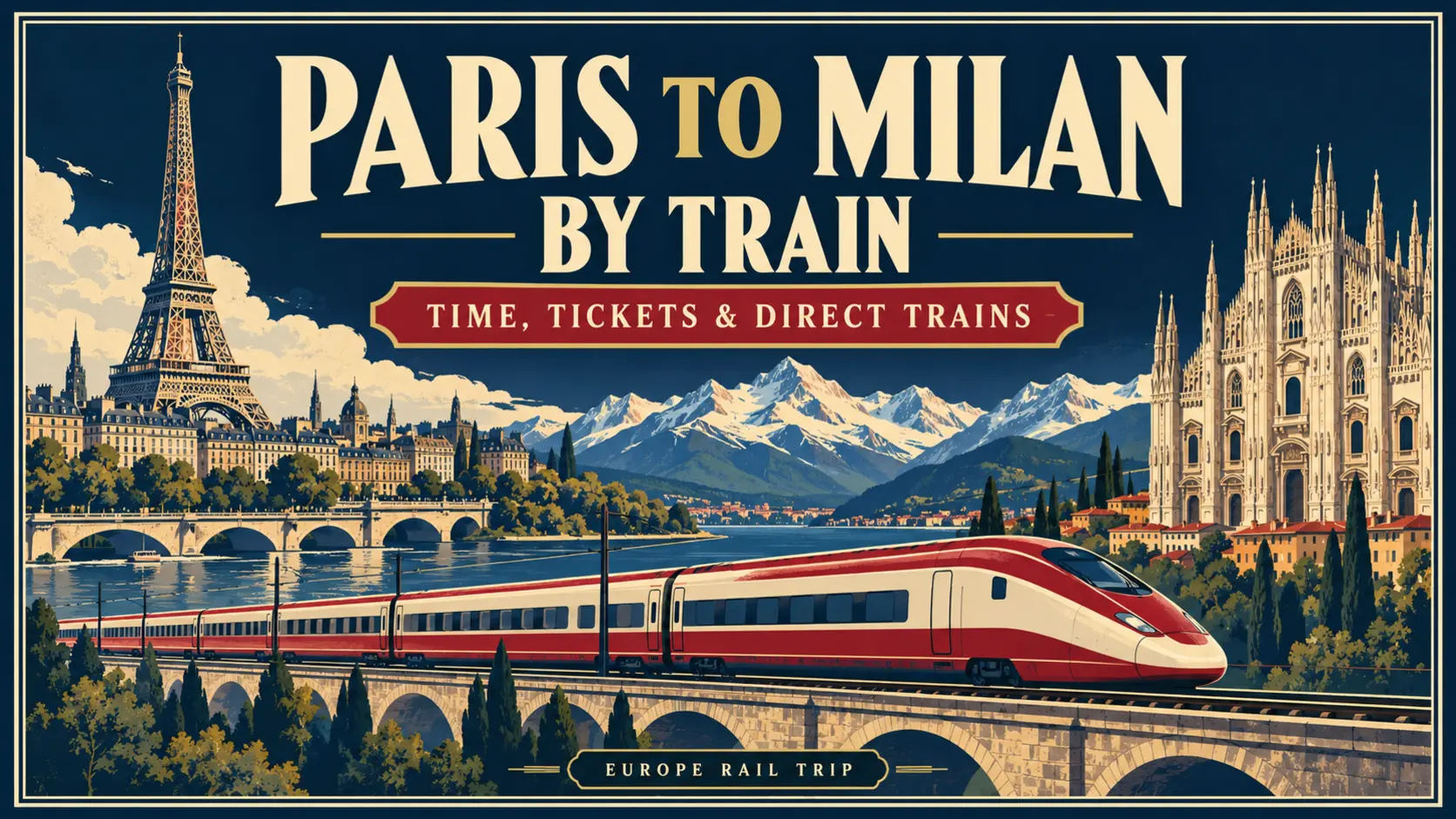
How long is train from Paris to Milan on a direct service?
Use about seven hours as the safe headline answer. Trenitalia describes its normal Paris–Milan journey as taking between 6h30 and 7h. A particular departure may be slightly faster or slower because the two operators use different stopping patterns and Milan stations.
The train is longer than a two-hour flight, but that comparison excludes airport transfers, security queues and boarding time. Gare de Lyon and the Milan terminals are inside their cities. For many travellers, the direct train remains a competitive full-journey option—especially with luggage.
| Normal direct journey | About 6h30–7h |
|---|---|
| Departure station | Paris Gare de Lyon |
| Milan station | Milano Centrale or Porta Garibaldi; check the operator |
| Direct operators | Trenitalia Frecciarossa and SNCF TGV INOUI |
| Changes | None on a direct train |
| Seat reservation | Included with a normal ticket; compulsory for passholders |
Normal journey time, frequency and stops checked on Trenitalia France’s official Paris–Milan traffic page and 2026 timetable page.
Important October 2026 disruption warning
At the time of checking, Trenitalia states that international trains are totally suspended from September 12 through October 9, 2026 because of works in France and/or Italy. That temporary closure overrides the normal direct timetable.
Do not buy accommodation or an onward non-refundable ticket from a generic “seven-hour” schedule. Search the actual travel date on the operator website. If no direct train appears, consider another date, a flight, or a longer route via Switzerland rather than constructing a fragile chain of replacement services.
Engineering information can change after booking. Verify the live train number and departure time, particularly for travel immediately after October 9 or around a timetable change.
Current suspension and works advice checked on Trenitalia France’s official traffic information page.
Is there a direct train from Paris to Milan?
Yes, under the normal timetable. Trenitalia says it operates two Paris–Milan round trips per day. SNCF Connect also lists direct TGV INOUI journeys. Both cross the Maurienne corridor through the French Alps and Turin before reaching Milan.
The convenience is simple: one seat, no airline baggage check and no station change. Direct service is the best option for most visitors when it runs. A one-change result may be useful if it is much cheaper, but compare the total time, transfer station and ticket protection before choosing it.
SNCF Connect identifies TGV INOUI as an operator on the route and describes Wi-Fi, power, luggage space and a bar carriage. Trenitalia’s 2026 timetable covers Paris, Lyon, Chambéry, Saint-Jean-de-Maurienne, Modane, Oulx, Turin and Milan.
Operator and onboard details checked on the official SNCF Connect Paris–Milan page.
Paris to Milan timetable and main stops
Trenitalia’s standard pattern includes morning and afternoon departures. Its traffic page lists normal Paris departures around 07:30 and 15:20, with Milan departures around 06:25 and 15:53. The operator’s timetable page says schedules are published through December 12, 2026.
| Route point | Why it matters |
|---|---|
| Paris Gare de Lyon | Central departure with Metro and RER connections |
| Lyon Part-Dieu | Major French stop; do not confuse it with Lyon Saint-Exupéry |
| Chambéry | Gateway to the Alpine section |
| Modane | French border corridor |
| Oulx | Italian Alpine stop |
| Torino Porta Susa | Useful connection for Turin and onward Italy |
| Milan | Confirm Centrale versus Porta Garibaldi |
These are timetable patterns, not a promise for every date. Weekend works, holidays and seasonal releases can remove a departure or change its time. Search by train number after booking and keep contact details current so the seller can send disruption notices.
Which Paris and Milan stations do you need?
Paris Gare de Lyon
All direct Paris–Milan trains leave from Paris Gare de Lyon. The station is served by Metro lines 1 and 14 and RER lines A and D. Several halls share the complex, so arrive about 30 minutes early if you have luggage or do not know the layout.
Travelling from London? Eurostar arrives at Gare du Nord, not Gare de Lyon. Use our Gare du Nord to Gare de Lyon transfer guide and leave a generous cross-city buffer. From the airport, the CDG to Paris guide explains the RER and taxi options.
Milano Centrale versus Porta Garibaldi
Trenitalia Frecciarossa uses Milano Centrale. SNCF’s TGV service may use Milano Porta Garibaldi. The stations are linked by Metro line M2, but they are not interchangeable when you have a tight onward connection.
If continuing to Rome, Venice or Florence, many high-speed trains depart from Centrale. Build at least 60–90 minutes for a separate-ticket transfer from Porta Garibaldi. Our Rome–Milan guide explains the domestic high-speed corridor.
How much does the Paris to Milan train cost?
There is no single reliable fare. Price depends on the date, operator, class, flexibility and how many cheaper seats remain. SNCF Connect recommends booking several months ahead and being flexible; promotional offers are capacity-controlled.
Compare the complete fare rules. A low non-refundable ticket is sensible only when the trip is firm. A flexible fare can be worth more during works or when the international train connects with another independently booked journey.
- Search the exact date on both SNCF Connect and Trenitalia.
- Compare the same departure time and Milan station.
- Open the exchange and refund conditions.
- Check the final price after seat and passenger details.
- Pay the operator you want to handle after-sales support.
Do not assume a reseller is cheaper. It may display both operators conveniently, but direct booking keeps changes and disruption support with the railway. Our European booking-window guide explains when schedules normally open.
TGV INOUI or Frecciarossa: which should you choose?
| Factor | TGV INOUI | Frecciarossa |
|---|---|---|
| Milan terminal | Check for Porta Garibaldi | Milano Centrale |
| Standard comfort | Power, Wi-Fi and bar | Multiple service levels, power and Wi-Fi |
| Pass reservation | Indicatively €31/€45 | Indicatively €13 |
| Best choice | Useful fare/time or SNCF booking | Centrale arrival or lower pass fee |
Choose the departure that fits the whole trip, not a brand name. A slightly more expensive train into Centrale can save a metro transfer. A TGV that arrives earlier may be better when you need an evening connection. Compare duration, terminal and conditions together.
SNCF says TGV INOUI provides luggage space in each coach, Wi-Fi and a bistro. Trenitalia’s Frecciarossa 1000 offers several comfort levels and luggage racks. Neither product removes the need to carry and supervise your own bags.
Can you use Eurail or Interrail?
Yes, a valid pass covering France and Italy can cover the base journey, but the seat reservation is compulsory. Interrail’s current international fee table lists Paris–Turin/Milan TGV reservations at €31 in second class and €45 in first class. The listed Frecciarossa reservation is €13 in either class.
Those figures are indicative and can change. Interrail also warns that its reservation service adds a booking fee. Passholder inventory may sell out before ordinary tickets, so reserve the international train before building the rest of an Italy itinerary.
Compare the pass reservation with a normal promotional ticket. Spending a pass day plus €31 is not automatically good value. Read our Eurail value guide and Eurail versus Interrail explanation before deciding.
Reservation requirement and indicative fees checked on Interrail’s official international reservation fee table.
Luggage, food and onboard comfort
There is no airline-style checked baggage process. Bring luggage you can lift onto the train and place in the overhead shelf or larger rack. Keep documents, medicine, money and electronics in a smaller bag at your seat.
SNCF Connect describes luggage space in each TGV coach. Trenitalia’s Frecciarossa information also identifies overhead bins and larger compartments in some coaches. Label the main case, never block the aisle and keep valuables under direct supervision.
A seven-hour trip is easier with water and a snack even when catering is scheduled. Onboard stock can run out and service can be interrupted. Our European train luggage guide recommends a suitcase size that is realistic for platforms, stairs and racks.
TGV facilities checked on SNCF Connect; Frecciarossa storage details checked on Trenitalia’s official service-level page.
Is the train better than flying?
The flight wins on time in the air. The train often wins on simplicity: city-centre stations, fewer baggage procedures, more usable seat time and no airport transfer at the Milan end. The best choice depends on the complete door-to-door trip.
| Choose the train when… | Consider flying when… |
|---|---|
| You value city-centre departure and arrival | The direct railway is suspended on your date |
| You want uninterrupted work or rest time | You find a strong nonstop fare and travel light |
| You carry luggage within rail limits | Your final destination is near a Milan airport |
| You are continuing through northern Italy | The seven-hour schedule does not fit the trip |
Compare departure door to arrival door. Add travel to the airport, recommended pre-flight arrival, security, boarding and the airport transfer in Milan. Then compare that total with arriving at Centrale or Porta Garibaldi.
Onward travel from Milan
Milan is one of Italy’s strongest rail hubs. Direct high-speed trains run toward Bologna, Florence, Rome, Venice and Turin, while EuroCity services continue toward Switzerland. Confirm the departure station before buying the onward leg.
For Venice, read the Paris to Venice guide, which owns the connection and station-transfer intent. For Rome, use the Paris to Rome guide. This page remains focused on the direct Paris–Milan segment so the three guides do not compete for the same search intent.
The Italy train travel hub compares domestic operators and station names. If you are constructing a multi-country itinerary, start with the France train travel hub and verify the international segment first.
Frequently asked questions
How long is train from Paris to Milan?
A direct Paris to Milan high-speed train normally takes about 6 hours 30 minutes to 7 hours. The exact time depends on the operator, stopping pattern and temporary engineering work.
Is there a direct train from Paris to Milan?
Yes. TGV INOUI and Trenitalia Frecciarossa normally operate direct daytime trains from Paris Gare de Lyon to Milan. Check the Milan station carefully because TGV and Frecciarossa may use different terminals.
Which station does the Paris to Milan train use?
Direct trains leave Paris Gare de Lyon. Trenitalia Frecciarossa uses Milano Centrale, while SNCF TGV services may use Milano Porta Garibaldi. Confirm the station shown on your ticket.
How much is a Paris to Milan train ticket?
Prices vary by operator, date, class and flexibility. The cheapest promotional fares are limited and rise as a train fills, so compare the same date on SNCF Connect and Trenitalia before buying.
Can I use Eurail or Interrail from Paris to Milan?
Yes, but a compulsory reservation is required. Interrail currently lists indicative reservation fees of €31 in second class or €45 in first class for TGV, and €13 for Frecciarossa.
Is Paris to Milan possible as a day trip?
No, not sensibly. A return journey would consume roughly 13 to 14 hours before station time. Stay at least one night or use Milan as the start of a longer Italy itinerary.
The practical verdict
Choose a direct train when it operates: about 6h30–7h, one seat and central stations make it the cleanest rail option. Compare TGV INOUI and Frecciarossa by arrival terminal, fare conditions and schedule rather than brand. For October 2026 travel, the works suspension is the first fact to check.
Build your Italy rail itinerary
Compare Milan with Rome, Venice and Switzerland before booking separate tickets.
Open the Italy train hub →Information checked October 2, 2026. Timetables, engineering work, fares, stations and reservation fees can change. Verify the exact journey with the operator before purchase.