Where Does the Glacier Express Start and End? Route Guide
The famous panorama train crosses Switzerland from the Matterhorn region to the Engadin. Here is the exact route, the useful boarding points and the sections worth prioritizing.
The full Glacier Express starts in Zermatt and ends in St. Moritz, or travels the same route in reverse. Allow approximately 8 hours. Major boarding points include Brig, Andermatt, Disentis/Mustér, Chur and Filisur, although exact stops vary by train. Some 2026 services run only part of the corridor, so check that your dated train is a through service.
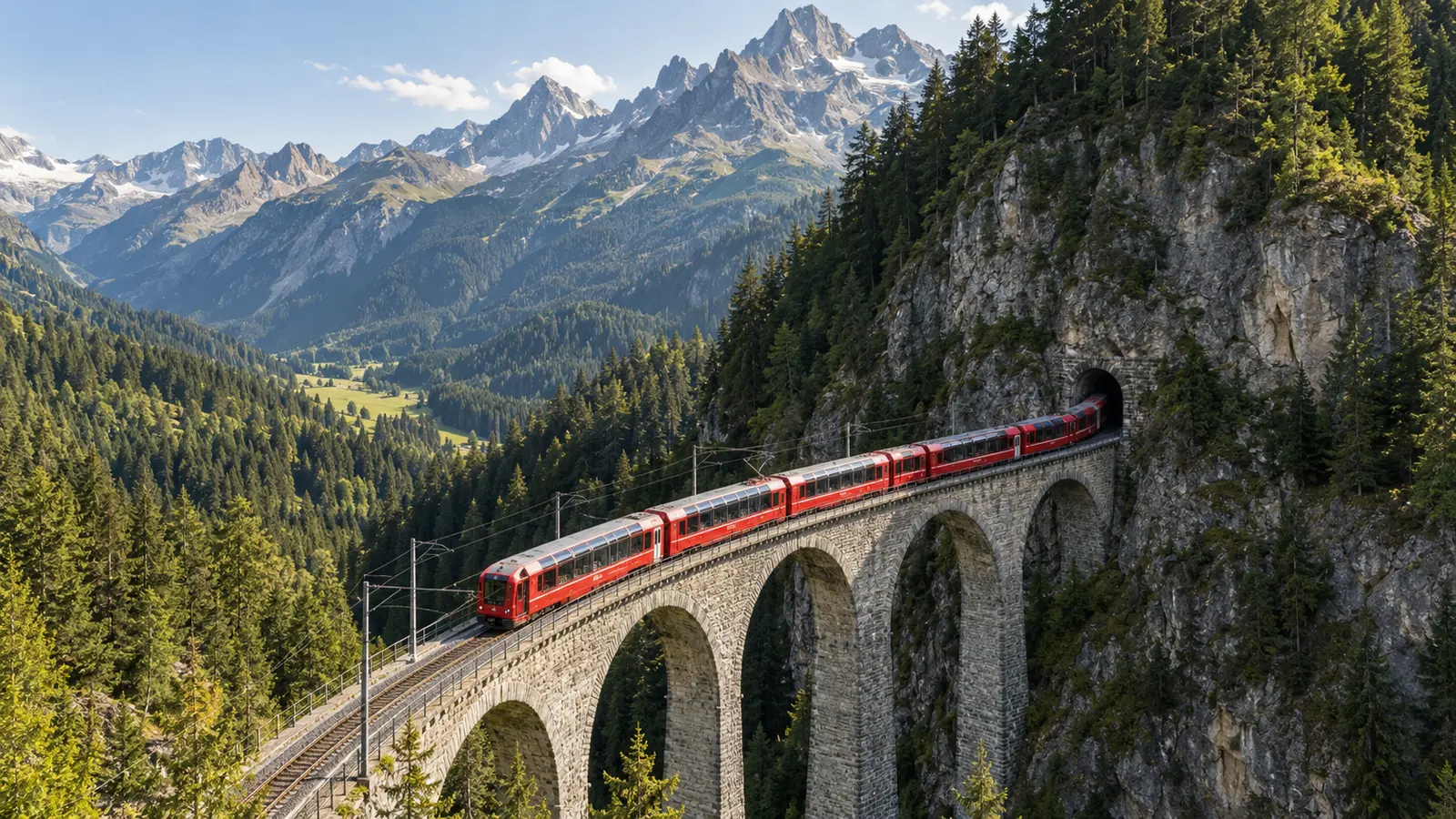
Glacier Express route at a glance
| Question | Answer |
|---|---|
| Western endpoint | Zermatt |
| Eastern endpoint | St. Moritz |
| Full journey time | Approximately 8 hours |
| Highest point | Oberalp Pass, 2,033 metres |
| Key boarding points | Brig, Andermatt, Disentis/Mustér, Chur and Filisur |
| Reservation | Compulsory on Glacier Express services, in addition to a valid ticket |
The name can be misleading: the Glacier Express is a slow sightseeing train, not an express in the modern high-speed sense. Its value is the uninterrupted panorama across several different Swiss landscapes. The official route describes a journey from Zermatt to St. Moritz of about eight hours.
Where exactly does the Glacier Express start?
At the western end, the Glacier Express starts at Zermatt station. Leaving Zermatt, the line descends the Matter Valley toward Brig. The official route highlights the Bis Glacier shortly after departure and the narrow Kipfen Gorge near Kalpetran.
Zermatt is the right starting point when the Matterhorn region is already part of your trip. It also creates a simple west-to-east story: mountain resort first, then the Valais valley, central Swiss Alps, Rhine Gorge and finally the Engadin. Starting here is not inherently more scenic than traveling westbound; it simply changes the order of the highlights.
Where does the Glacier Express end?
The complete eastbound journey ends at St. Moritz station. In the opposite direction, St. Moritz is the starting point and Zermatt is the destination. The final approach uses the Albula railway, one of the most impressive engineering sections on the route.
Davos is not the eastern terminus. If your trip begins or ends in Davos, the official route tells passengers to change at Filisur. That distinction matters when booking accommodation or an onward train: do not search for a direct Glacier Express from Zermatt to Davos.
Glacier Express stops from Zermatt to St. Moritz
The useful route sequence from west to east is:
Zermatt → Brig → Andermatt → Disentis/Mustér → Chur → Filisur → St. Moritz.
Depending on the specific service, the timetable may also show intermediate calls such as Tiefencastel, Bergün, Samedan or Celerina. Not every Glacier Express train serves every listed station, and not every train runs between both endpoints. Treat the sequence above as a planning map, then verify your train number on the dated timetable.
| Stop or section | Why it matters | Useful for |
|---|---|---|
| Zermatt | Full-route western endpoint | Matterhorn stays and the complete journey |
| Brig | Valais junction and a starting point for some services | Connections from western Switzerland or Italy |
| Andermatt | Before the climb to Oberalp Pass | A shorter high-Alpine section |
| Disentis/Mustér | Between Oberalp Pass and the Rhine valley | Access to eastern Graubünden |
| Chur | Major city and boarding point; some trains terminate here | A shorter ride over the Albula route |
| Filisur | Near Landwasser Viaduct; connection for Davos | Railway engineering and Davos trips |
| St. Moritz | Full-route eastern endpoint | Engadin stays and onward Bernina journeys |
How long does the complete Glacier Express take?
Plan on approximately eight hours. As a concrete example, the official summer 2026 timetable lists PE 902 from Zermatt at 08:52 to St. Moritz at 16:37—a journey of 7 hours 45 minutes. Another through service has different times, and shorter trains may start at Brig or Chur instead of Zermatt.
The long duration is a feature only when you want the train to be the main event. If eight hours of continuous sightseeing feels excessive, board for one or two signature sections rather than choosing the full journey out of obligation.
Route, endpoints, elevations and highlights checked on the official Glacier Express route page. Train times, operating periods and reservation rules checked on the official Glacier Express timetable.
Best scenic sections of the Glacier Express
Andermatt to Disentis: best for a high Alpine pass
East of Andermatt, the line climbs to the Oberalp Pass at 2,033 metres, the highest point of the Glacier Express. Choose this section for open mountain scenery and the feeling of crossing the Alps rather than following a valley floor.
Disentis to Chur: best for the Rhine Gorge
As the route approaches Chur, it follows the Rhine through the pale cliffs and wooded slopes of the Rhine Gorge, often called the Swiss Grand Canyon. This section is a strong choice when you want dramatic natural scenery but cannot commit to the full Zermatt–St. Moritz day.
Chur to St. Moritz: best for viaducts and railway engineering
The eastern section includes the Landwasser Viaduct near Filisur and the Albula line. The official route identifies Preda–Bergün as its most spectacular part, with high viaducts, spiral tunnels and helical tunnels that gain altitude in a compact mountain landscape.
If your priority is the classic railway photograph and the most concentrated engineering, choose Chur–Filisur–St. Moritz. If you care more about high mountains, Andermatt–Disentis is the better match. There is no need to call one section objectively best.
Which direction is better?
Both directions cover the same railway. Eastbound from Zermatt places the Oberalp Pass and Albula highlights progressively later in the day; westbound from St. Moritz brings the Albula section early and finishes in Zermatt. Choose direction around your hotels and onward connections.
Do not build the trip around a universal “best side” of the train. The track changes direction repeatedly through curves and tunnels, while important views appear on both sides. Panorama windows and a route that twists across the Alps make itinerary fit more important than a fixed left-or-right rule.
Can you take only part of the Glacier Express?
Yes. The official timetable contains both through journeys and services that begin or end at intermediate stations. Chur, Andermatt and Brig are especially useful for reducing the length of the day. A Glacier Express seat reservation remains compulsory even when you ride only part of its route.
Before paying, check three separate details: the train’s origin, its final destination and whether it stops at both stations you selected. A search result labeled Glacier Express does not automatically mean a full Zermatt–St. Moritz run.
The official timetable states that no Glacier Express trains operate from October 11 to December 4, 2026. Engineering work and timetable updates can also change individual services. Verify your date before planning hotels around the train.
Tickets, passes and the compulsory reservation
A journey requires a valid transport ticket plus a separate mandatory Glacier Express seat reservation. The official timetable says the Swiss Travel Pass, Eurail, Interrail and Saver Day Pass are among the products accepted for the transport portion, but they do not remove the reservation requirement.
Tickets can be available up to six months ahead. The official booking guidance lists first- and second-class seat reservations up to 93 days before travel, while Excellence Class follows its own availability. Decide whether the premium makes sense in our Glacier Express value comparison, then use our Swiss Travel Pass value guide for pass break-even examples. This page intentionally keeps its focus on the route rather than duplicating those cost decisions.
How this route fits a Switzerland itinerary
The complete Glacier Express works best as a bridge between stays in Zermatt and the Engadin. It is less efficient when you must backtrack to reach either endpoint. Our 7-day Switzerland train itinerary focuses on Lucerne, Interlaken and Zermatt, so adding St. Moritz usually requires extra nights rather than squeezing the panorama train into an already full week.
If you are still deciding between famous Swiss trains, compare duration, landscape and reservation effort in our best scenic trains in Switzerland guide. That comparison owns the question “which train is best”; this guide owns the Glacier Express route itself.
Frequently asked questions
Where does the Glacier Express start and end?
The complete Glacier Express runs between Zermatt and St. Moritz in either direction. The full journey takes about eight hours. Some dated services cover only part of the corridor, so confirm that your chosen train runs through to the endpoint you need.
Can you board the Glacier Express at Chur?
Yes. Chur is a major boarding point on the Glacier Express route, and some services begin or end there. Check the dated timetable because the calling pattern and final destination vary by train.
Does the Glacier Express go to Davos?
The Glacier Express does not use Davos as an endpoint. The official route advises passengers traveling from Davos to connect with the Glacier Express at Filisur.
How long is the full Glacier Express route?
A full Zermatt–St. Moritz trip takes approximately eight hours. For example, the official 2026 summer timetable lists a morning through service taking 7 hours 45 minutes, but exact times depend on the train and date.
What is the most scenic part of the Glacier Express?
For railway engineering, the Albula section around Filisur, the Landwasser Viaduct and Preda–Bergün is the standout. For high-Alpine scenery, choose Andermatt–Oberalp Pass–Disentis; for dramatic river landscape, choose the Rhine Gorge west of Chur.
Can you ride only part of the Glacier Express?
Yes, subject to the stops and availability on your chosen service. Chur, Andermatt, Brig and other stations can be used for shorter journeys, but a compulsory seat reservation is still required when traveling on the Glacier Express itself.
The practical verdict
The complete Glacier Express connects Zermatt and St. Moritz in about eight hours, with Brig, Andermatt, Disentis/Mustér, Chur and Filisur among its key boarding points. For the full narrative of the Swiss Alps, ride endpoint to endpoint. For a shorter trip, choose Andermatt–Disentis for the high pass, Disentis–Chur for the Rhine Gorge or Chur–St. Moritz for the Albula railway.
Whichever section you choose, confirm the exact train, date and endpoint before booking. That single check prevents the most common route mistake: assuming every Glacier Express service covers the entire corridor.
Best scenic train rides in Switzerland
Choose between Glacier, Bernina, GoldenPass and other scenic routes by time, landscape and reservation rules.
Compare the scenic trains →Information checked September 20, 2026. Timetables, calling patterns, seasonal operation and reservation windows can change. Verify the live dated service with Glacier Express before booking.